From Nuclear Fission to Sahara Dust: Sudanese Scientist on the Physics of Sand Movement
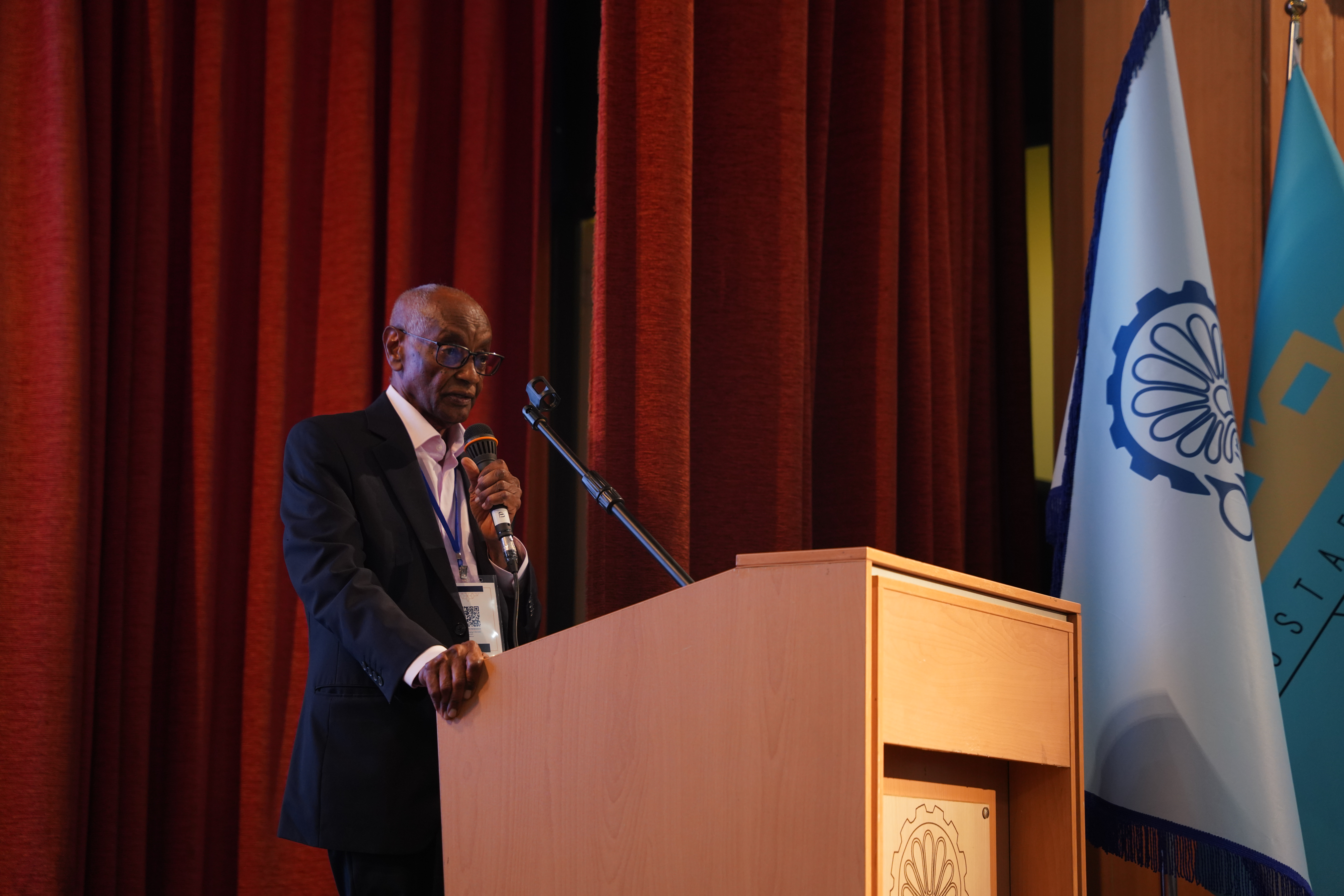
Professor Hassan, a co-founder and former president of TWAS, has served in top-tier scientific committees and organizations. He has published valuable studies in theoretical plasma physics, sustainable energy, and environmental and geophysical phenomena, such as dune migration patterns.
MSTF Media reports:
Professor Mohamed Hag Ali Hassan is one of the most influential African scientists and well-known figures in advancing science in the Global South. Holder of a PhD in Plasma Physics from the University of Oxford, the Sudanese scholar has played a remarkable role in improving science institutes and supporting research in developing countries.
In an interview with the MSTF, pointing out the connection between his two fields of specialty, nuclear physics and migration of dunes, Professor Hassan stated, “The major link between these two fields lies in the mathematical equations governing them. Looking closely at the movement of sand by the wind in the desert, we see that there are two elements at work: light-weight sand, which is free to move, and the wind. One represents the moving current, the other, fixed background.”
The prominent physicist explained that when he was studying plasma (a gas as hot as the sun) and trying to understand the motion of small ions and electrons and how they move in a magnetic field, he realized that the equations were remarkably similar to the diffusion equations he had developed to study the movement of sand.
“Only the parameters were different, but the structure of the equation was more or less the same,” he stated. “In other words, many of the mathematical equations I had used to study plasma physics and nuclear fusion were also useful for understanding environmental phenomena, such as the movement of sand in the desert".
Asked which of these two fields of research he prefers, Professor Hassan said: "At the beginning of my career, I worked a lot on nuclear fusion because we believed that we would soon reach an important achievement in this field and that this very hot gas could be confined in a specific chamber at a temperature of 100 million degrees Fahrenheit. But the chamber must use a magnetic field mechanism to keep the hot gas inside and prevent it from escaping."
When Professor Mohammad Hassan started carrying out research in this area in the late 1960s and early 1970s, physicists were optimistic that this achievement would soon be realized, but they did not understand the fundamental problem, i.e., instability.
“They heat the gas as much as possible, then they restrain it using magnetic fields,” he maintained, “but this is not stable. When it reaches a certain temperature, it explodes and destroys everything. To this day, scientists have been trying to solve this problem".
The Sudanese researcher further spoke about the environmental problems in his home country, Sudan, which are of special interest to him. “Phenomena such as sand, wind and dust, modeling the movement of dust in deserts, environmental pollution and understanding how it moves are among my main research interests,” he said. “Dust moves in the atmosphere and it is intriguing to discover how it moves. Dust has been one of my focuses, particularly in the Sahara Desert."
Professor Mohamed Hassan pointed out the large amount of dust that is released from the Sahara Desert, reaching the atmosphere; these are tiny particles that can travel long distances in the air. According to him, “all of Europe was covered in Sahara dust about a year ago. This was the dust whose movement I was trying to change. A lot of it crosses the Atlantic Ocean, reaches the US and Florida and is deposited in Florida and the Amazon."
However, for Africans, dust bears great significance since it is the main soil particle that they need for irrigation and soil fertility. A lot of this dust settles in the Amazon, and according to some experts, the Amazon owes it lushness to this dust coming from the desert.
One downside of dust is that it is capable of covering large areas, in which case it can be harmful for the environment. In general, however, agricultural lands need these particles.
In this way, the prominent physicist’s research on the movement of sand, though not directly applicable to industry, is very important for the environment.
Professor Muhammad Hassan also warned about the danger of dust emissions for the body and eyes and how it can be disastrous for human beings when the entire environment becomes dirty and full of particles.
Asked whether hydrogen bombs work in the same way (referring to the previously mentioned issue of nuclear fission and the problem of its containment), the professor clarified: "That's right. They create the energy of the hydrogen bomb and they contain it, then they immediately convert the energy into electricity. So, nothing is destroyed. You just take the energy of the hydrogen bomb, but you contain it and convert it into electricity, and that's the whole idea".
Regarding the reason why scientists cannot use another gas instead of deuterium and tritium, he said, “Apparently these gases are more efficient and abundant. They can also be obtained from the sea and are considered unlimited resources.”