Columbia Shuttle Disaster, Blue Jets, and a Global Lightning Network
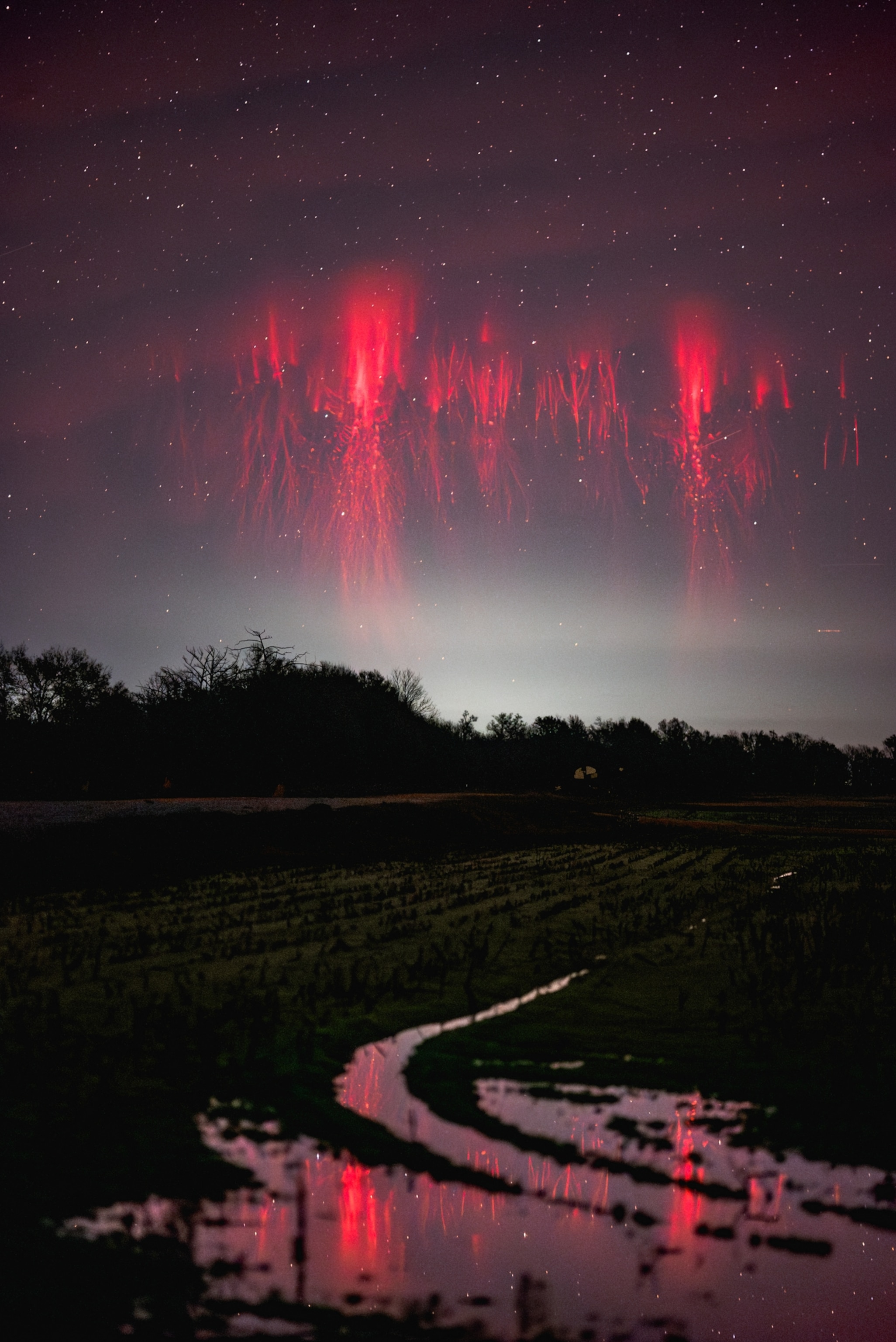
From proving that mysterious red sprites posed no threat to the Columbia space shuttle to helping create a global lightning locating system accurate to within milliseconds, Professor Umran Inan’s research has linked fundamental science with practical technologies used around the world.
MSTF Media reports:
In the third part of our interview with the prominent space scientist and a 2019 Mustafa(pbuh) Prize laureate, Professor Umran Inan, the conversation turns from the discovery of transient luminous events to the broader impact of those findings.
Inan pointed out one of these phenomena, stating that sometimes, the electric field created is so strong that a simple glow is no longer seen in the sky, but sparks are formed that grow to higher altitudes.
“The strong electric field leads to the creation of sparks that start to grow, ionize the air in front of them, and continue at an altitude of about 40 kilometers, much higher than the flight path of airplanes,” he observed.
Later known as Blue Jets, these phenomena are another type of transient light events that, unlike red sprites, move from above storm clouds into the upper atmosphere.
According to the Mustafa(pbuh) Prize laureate, the study of these phenomena showed that the relationship between lightning and the upper layers of the atmosphere is much more complex than hitherto thought.
Could Red Sprites Have Caused the Columbia Shuttle Disaster?
An important stage in Inan’s research was the investigation of a hypothesis that was put forward after the Columbia space shuttle accident.
He says that after the shuttle crash in 2003, his research team was asked to investigate whether transient optical events, especially red sprites, could have played a role in the incident.
They rejected this hypothesis.
“It was not possible for red sprites to have caused the disaster,” Inan maintained, “because these phenomena do not have high electrical conductivity and occur at altitudes much higher than the cruising altitude of airplanes and shuttles.”
According to him, these studies once again showed that transient optical events, although significant events, do not have a direct impact on the safety of flights.
Giant Telescopes to Study Microstructures of the Atmosphere
The study of red sprites was not limited to capturing images. Inan and his colleagues also attempted to investigate the structures of these phenomena in detail.
To this end, they used very large telescopes that could only be carried by gigantic trucks.
“We used huge telescopes to observe the very fine structures of the atmosphere," he said. “Using these same telescopes, one of my students was able to measure details that were previously invisible.”
These observations showed that red sprites and other transient optical events have much more complex structures than what was seen in the initial images. This radically changed the direction of subsequent research.
From Earth's Atmosphere to Jupiter's Radiation Belts
Their studies were not limited to the Earth's atmosphere. Inan says that after years of research on the interaction of waves and particles around Earth, a part of his team’s research was then devoted to the radiation belts of Jupiter.
However, he emphasizes that the major focus of their activities was devoted to the space environment around the Earth.
“We have spent most of our time studying the Earth, waves, particles, and phenomena that are guided by electromagnetic waves,” Inan observed.
The space scientist further pointed out the interesting behavior of these waves. Waves produced by a lightning strike in North America, he said, can travel along the ionosphere and the Earth's magnetic field and can even be detected in the Southern Hemisphere.
Passing through different environments, these waves carry valuable information about the characteristics of that environment, information that can be analyzed to determine the density of plasma and other physical properties of near-Earth space.
Where Engineering and Physics Converge: Stanford's Research Advantage
Asked about the key factor behind the success of his research, Inan stated that he believed the scientific atmosphere at Stanford University to have been one of the main reasons.
Referring to the demographic of the university, he said that unlike many physics and astronomy departments, Stanford's Electrical Engineering Department had a very large number of graduate students, which made it possible to select talented researchers.
“Stanford's electrical engineering department had about 600 PhD students, while many physics and astronomy departments typically had no more than 30,” he pointed out.
Therefore, he was able to select a group of the best talents from among these students to collaborate on research projects. At one point, about 60 doctoral students were working directly with him.
Inan believes that the presence of these elite students, along with the engineering approach that dominated the research group, was one of the most important advantages of their research, because in addition to providing theoretical models, they also had the ability to design and build the required equipment. This was a capability that many research groups active in the field of atmospheric physics did not possess.
From Training Researchers to Designing Unique Tools
Inan further stated that a significant factor in the success of his team was utilizing top students and combining an engineering perspective with basic science research.
According to him, most researchers active in the field of atmospheric and space physics worked in the departments of physics or astronomy, but his presence at Stanford's Department of Electrical Engineering made it possible to design and build the equipment needed to conduct experiments in the same department, in addition to providing theoretical models.
“Our job did not involve merely presenting theory," Inan says. “We designed tools that were specific to our own research. We even sent students to Antarctica to conduct field experiments.”
His team designed highly sensitive receivers that could measure very small changes in the Earth's magnetic field.
They had incredibly accurate equipment such as receivers that could receive very weak signals from a distance of about 600 kilometers. “We measured very small fluctuations in the Earth's magnetic field using this self-made equipment that had no equivalent anywhere in the world at that time.”
Building a Global Lightning Locating System
Another noteworthy achievement of Inan's team was the development of a method for accurately locating lightning. Having emerged from the doctoral dissertation of one of his students, this research later became a global technology.
Explaining the project, he said that every lightning bolt, when striking, produces radio waves, and if these signals are received simultaneously at several stations, the exact location of the lightning strike can be determined.
“If you can measure the lightning signal at multiple points, you can pinpoint its exact location, like a triangle, using the direction of the waves,” Inan says.
A Finnish company later received a patent for it, setting up a network of special receivers in different parts of the world.
Today, dozens of stations in different countries, including Turkey and Spain, are connected to this network, and the collection of these stations covers almost the entire surface of the planet.
Recording Every Lightning Strike with Millisecond Precision
The system developed in collaboration with his team is now able to record the time and location of each lightning strike with very high accuracy.
“We can now record each lightning strike with the time accuracy of one millisecond and the spatial accuracy of about one kilometer, which means we know exactly when and at what point each lightning strike has occurred,” he added.
This information is not only of research value but is also used in many real-world activities. He explains that airlines use this data to reroute flights when approaching storm systems to avoid high-risk areas. Insurance companies also use this information to verify claims in the event of damage caused by lightning strikes.
“If someone claims their house caught fire due to lightning, the insurance company can check whether lightning actually occurred at the said time and place,” Inan says.
A Valuable Database Since 2009
The veteran space researcher further pointed out the importance of the data collected through their technology, saying that scientists have access to the database containing information on all lightning recorded since 2009 which they can use to conduct scientific studies.
“My students and I use this data for scientific research. Every lightning strike that occurs anywhere in the world is recorded in this system,” he added.
The study of this data has shown that the occurrence of lightning follows specific time patterns. For example, in the Northern Hemisphere, the highest lightning activity occurs in the summer. In the Southern Hemisphere, too, this trend coincides with the warm season in the hemisphere.
They have also found that the number of thunderstorms is usually lower in the morning, but their number increases from the afternoon to the evening hours as atmospheric instability increases.
“Thunderstorm meteorology is very interesting to me and perhaps for good reason; my father was a meteorologist. He predicted the weather, and later, after I became an electrical engineer, I returned to studying lightning and weather. Of course, this time from a different angle.”
A Discovery That Continues
Inan believes that despite decades of research, many questions about transient optical events are unanswered. The discovery of red sprites, elves, and blue jets was not the end of the road, but rather the beginning of a new chapter of research, as each answer presented new questions to researchers.
Some of the biggest ambiguities that still occupy the minds of scientists, Inan says, are as follows: why some storms produce red sprites and others do not. Why, sometimes, very complex branching structures form and other times only a luminous halo is seen? And, can artificial intelligence and quantum computing help answer these questions in the future?
?The Secret of the Red Sprites: How Does Lightning Illuminate the Sky

Nanomembranes: Tiny Filters with a Big Role in Securing the Water of the Future
Stimulus-Responsive Nanoparticles Promise a New Era of Automated Drug Delivery
New Advances in Nature-Inspired Cancer Detection and Targeted Treatment