From Coding Theory to Chiplets: How Amin Shokrollahi Transformed Global Communications
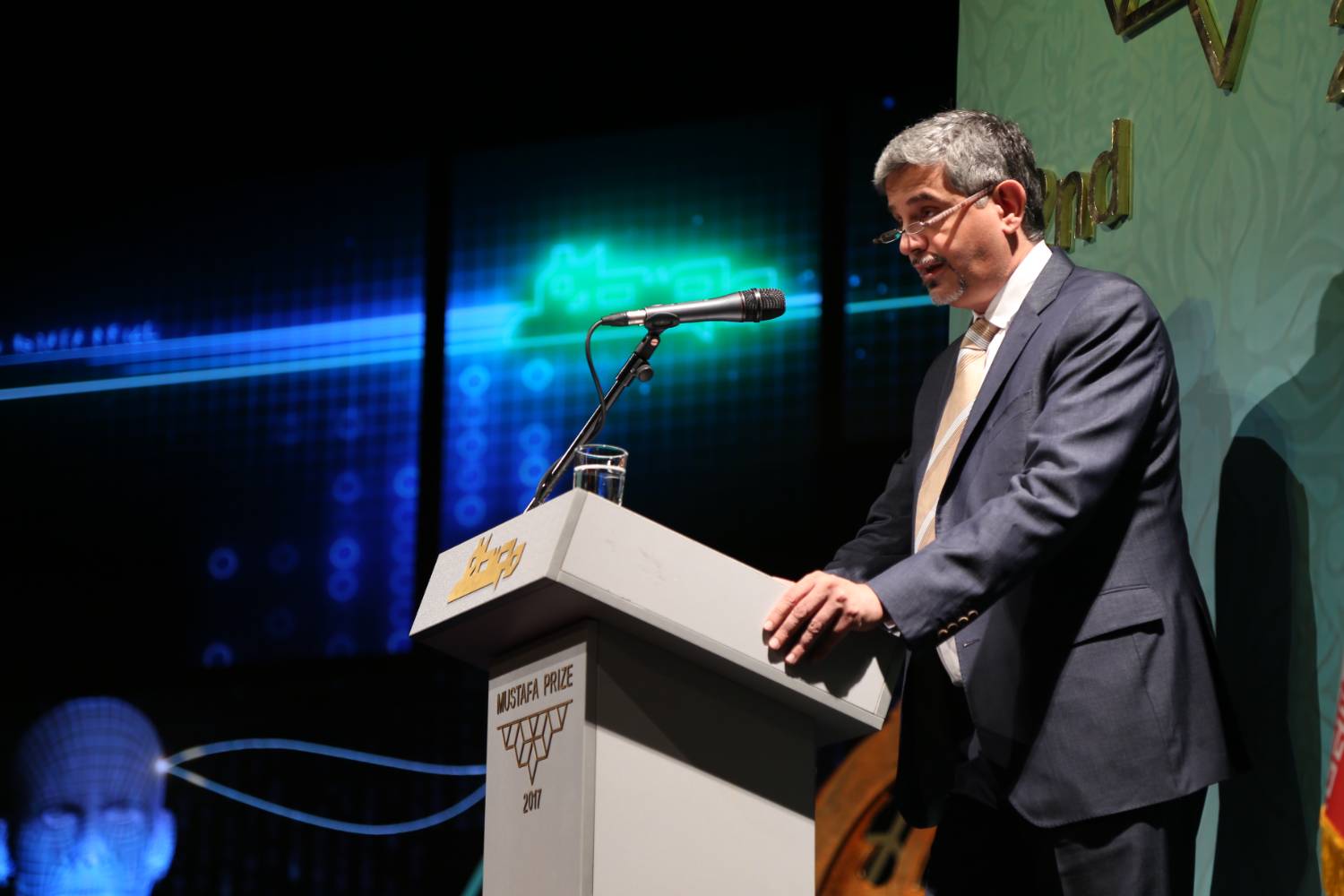
In our in-depth interview, Professor Amin Shokrollahi went through his love for mathematics that arose from his early family teachings, his studies in Germany, and tying his learnings with the industry and entrepreneurship in different countries.
MSTF Media Reports:
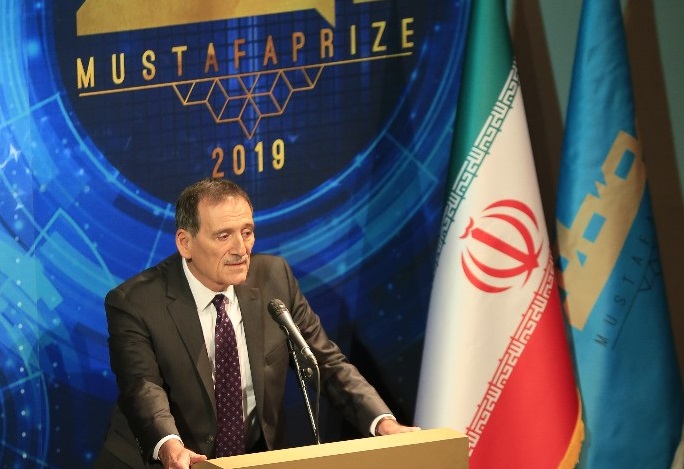
Mohammadamin Shokrollahi, renowned mathematician and Mustafa(pbuh) Prize laureate, in an interview with Mehr News Agency, talked about his life in Iran from elementary school to high school, his university life in Germany, and his career path in the U.S., elaborating on his academic achievements so far and his future plans.
Asked about his BSc dissertation and how he had come upon the subject, the raptor code inventor noted: There is a conjecture in coding theory which I am still trying to solve since nobody has solved it so far. I wanted to find out if there was a code among the new codes that might contradict the conjecture. This was what I investigated. I managed to show that some codes can’t contradict it. For these codes, I proved that the conjecture is correct. It was interesting and not fun at the same time, because I really wanted to solve the conjecture. I realized that I can use these kinds of codes in the computational complexity theory. I did the second part which then turned into my dissertation.
The Vital Issue is Matrix Multiplication
Emphasizing the fact that matrix multiplication really matters to him, he talked about his post-doctoral research with Michael Luby: In Berkley, we did so much work with Mr. Luby. Their team worked on erasure codes using algebraic coding. When I started working with them they said we could use coding that is not algebraic. There was an algorithm that they did not know how to deal with. It was a good one but its correction capability was not satisfactory. For algebraic codes, you could use some combinatorial features to show that the code can correct the error in practice. Finding the algorithm is really hard. As a matter of fact, you focus on combinatorial features of the code and then you find the algorithm. However, the new codes we developed had definite algorithms. We decided that we wouldn’t meddle with algorithms that were difficult. We would change the structure of the code instead, so that the algorithm worked well.
The Mustafa(pbuh) Prize laureate added: Since I am highly skilled in basic math, I was able to solve the problem using differential equations, showing that there are things called graphs. If you design graphs in a manner that they have important features, the algorithm will work well. If you ignore the math part, none of these codes can do anything. We did it and started a new branch in coding. I worked on different issues. For example, one was to see whether the codes developed in graphs reach the channel capacity or not. In order for them to reach the capacity, meticulous alterations had to be made in the graphs. I tried to find new methods to do so. At the same time, I worked on computational complexity and designing new coding models with my students. The last student I worked with was Mr. Hesam Salavati who went back to Iran and I think founded two companies. Then, I received a fund of 2 million euros from Europe, which I used to enhance my laboratory. Each member at this lab worked on a specific issue. I had a post-doctoral student with whom I wanted to develop codes for Digital Subscriber Lines (DSL). The student made some traces, then, somehow found out that we needed to know what the problems were so we could make codes for them. Then, the student said something like, “we have a differential lane here.” Differential lane is a concept in electronics which I was not familiar with back then. After the student explained the concept an idea occurred to me: Instead of taking the wires separately, we could group them into four wires or so. Then, I explained this through the Hadamard matrix and inquired if we could use it. The student said that nobody has ever done so. Therefore, I urged the student to investigate further to make sure if a study was published on this.
A Plan that Morphed into an Invention and, then, a Company
Shokrollahi went on: I was certain that somebody must have written an article on the subject because the idea had occurred to me in only five minutes. The student said that no such article exists. We continued our research on the subject and I learned electronics. Then, we needed to find a good analog electronic engineer to design the analog circuits. We employed a guy named Armin Tajali for post-doctoral research using the same Europe fund. As we went on, I realized that this study should not be a research article; rather, a company needs to be founded for it.
In this field of study, it doesn’t matter how many articles and formulas you write or how many simulations you make; no one will believe you until you make a chip. Mr. Tajali and his team made the first chip and we spun it off EPFL. We were deciding on a name for the company. I consulted my wife about it and she inquired about the nature of the company. I said that we used vectors. She suggested ‘HIVE’ for High Impact Vector Signaling. But we found out Phillips had already used the name. My wife, then, asked what the word for “hive” was in Persian. I answered, “Kandou,” which she loved because it is both easy to pronounce in English and puns on the phrase “can do.” There was already a website with the word “candoo” so I went for “kandou” which was also a website. Fortunately, we were able to pay some money to free the name and use it for our company.
Asked about the affiliation of Kandou with the EPFL university since the company is located in the university’s science and technology park Shokrollahi stated: the technology park is located there and when a documentary on my life was being made there in 2017, everyone worked there. However, now, it has become more or less a company. They made a building just for us, which was too big because our team consisted of people working from Switzerland, the U.S., and England. Ultimately, we were given half a floor of the building. Then, I asked for a lab with temperature control and they provided it for us. We were to pay one-tenth of the money spent on all this in ten years to come. We did the primary research for the company in 2010, and, the next year, we established it.
Asked to name his most important invention from Tornado to Raptor and Kandou he replied: I believe the most influential enterprise has been Kandou, that is, if the industry receives it as well as I expect. When you consider phones, computers or data centers, data transfer is of crucial importance. Currently, for Artificial Intelligence we have some important parts: graphics processing unit (GPU) and memory. Making connections to memory is made frequently during inference. The infrastructure for these is data transfer, which need to be fast. AI has made a lot of trouble for the industry because the latter can no longer handle all the data that needs to be transferred. Today, there are four large data centers in the U.S. Facebook is the smallest and Amazon, the biggest, directly followed by Microsoft and Google. There are also several data centers in China and that’s it. Other countries don’t have any. So, what with the incapability of the industry to meet the demands and the critical issue of data transfer, they now publicly announce they do not care about standards; they just want companies to bring a technology or product that works so they can use it in the systems. In the past, in the industry of electronics, each company had a section for production and implementation. When they found the financial toll to be too big for them, they except Intel started working with the Taiwanese company, TSMC. Right now, each company wants to go back to working by itself. Standards do not matter anymore because these companies just want to surpass their rivals; what matters is building chips. We are living at a time in history when we face worldwide political issues on the one hand particularly between China and the U.S. and critical issues of energy and expanding data centers on the other hand. In the past, we did not face these problems.
The Story of Chiplets and Six Popular Products
Shokrollahi also maintained that their first contract was signed with Marvell an American company developing semiconductors and related technologies, whose headquarters is in Santa Clara, California. He highlighted: up until making that deal we had no products. At that time, Kandou was a start-up owned by a mathematician with limited knowledge in electronics. They took a risk by signing with us. Chips can be made in several kinds. For examples, there are big chips consisting of a memory and a CPU, both of which connect on the chip. The problem is that it is not possible to make a big chip because they consist of numerous parts and the design becomes complicated. There is a limit for how big you can make a chip. Marvell suggested that instead of making a big chip, we should make small parts, or chiplets. Data transfer between the parts needed to be fast and consume little energy so that we could have something equal to a big chip. With these parts, you can make many products, just like with Legos. The data inside the chips sold by Marvell belonged to us alone. This meant that if our technology didn’t work, six products by the company which were highly-demanded, would go to waste. They took the risk anyway and other companies, after Marvell, bought our products.
Kandou’s 300 million dollars of investment and 600 patents
Shokrollahi went on: Assembling chiplets in a new form was a whole new risk which paid off and everyone else suddenly paid attention to it. They all had their own specific standards. We did not get involved in the rivalry regarding standards. We decided to do something unprecedented. But the chiplet designed in 2016 still works. The developments in this industry take place so rapidly that nine years in it feels like four eras in geoscience. They feel like prehistoric times but the products are still great. We introduced an innovation that changed the whole industry. Unfortunately, we did not reap the full economic benefits, because big companies monopolized it. We are not one of those companies with huge investment. Nevertheless, there has been an investment of 300 million dollars in Kandou. Probably, there will be another 700 million dollars investment. We also have 600 patents.
An Invention that Speeds Up Data Transfer by Four Times
Asked which of the inventions in Kandou is the most significant one, Shokrollahi answered: Obviously, chord signaling is the most important one. It is a new technology that we have not yet talked about. It accelerates data transfer by four times using much less energy. Currently, standard dictates that 200 gigabytes per second can be sent through a pair of wires. Even the industry does not know how to turn the 200 gigabytes to 400. Using a new technology called Helix—not just chord signaling—we can achieve 800 gigabytes.
‘We Want to Investigate AI’s Infrastructure’
Asked about the future ramifications of Kandou’s technologies and how they relate to AI, Shokrollahi explained: As I said before data transfer needs to be speedy and low maintenance in terms of energy. This is what we exactly work on at Kandou. We investigate the infrastructure of AI. One of our products currently does that, but not as efficiently as I explained before. Initially, we need to produce the chip, which is a time-consuming and costly process. For example, a chip costs 70 million dollars for us. Mostly, it is because of the payment of the employees who design it, and then it is the cost of testing and manufacturing. For example, the fabrication of the new chip I talked about takes at least 30 million dollars.