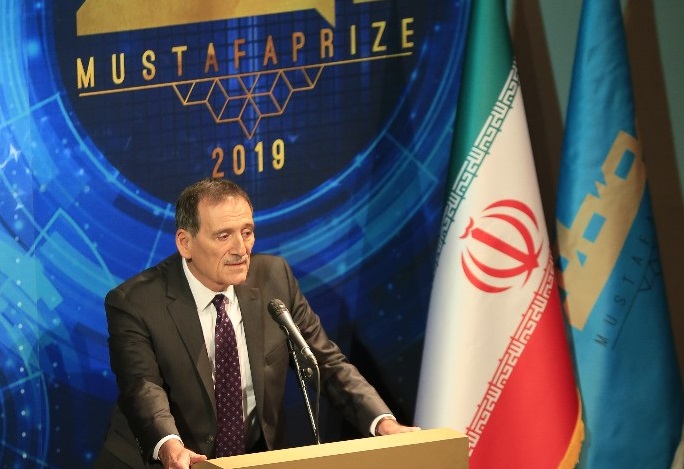
Omar Yaghi, prominent chemist and professor at California University, a 2015 Mustafa(pbuh) Prize laureate and a Nobel Prize winner, maintains that a new generation of materials, to whose formation he has contributed significantly, are likely to revolutionize the next century. Only a few grams of these Crystalline and extremely porous materials called Metal-Organic Frameworks (MOFs ), can have an internal surface area comparable to the size of a soccer field.
MSTF Media reports:
From the Stone Age and the Bronze Age to the contemporary Silicone Age a title owing to chips and electronical devices eras of human civilization throughout history have each been marked by a characteristic material, i.e. stone, bronze, iron, etc. Yaghi believes we are now on the threshold of a new age, an age that might be defined by ultra-porous materials that offer storage, separation and reactivity of chemical material at an unprecedented level.
MOFs and their sub-class, Covalent Organic Frameworks (COFs), are built from molecular components combining to form an organized structure and three-dimensional networks with countless pores. What distinguishes these materials from other solids of the same category is their high porosity. In 1999, Yaghi and his team synthesized a zinc-based material called MOF-5, showing solids can be formed with volumes consisting almost entirely of empty spaces. The inter surface of this material is substantially bigger that its outer surface, a feature that allows the absorption and storage of a great number of other molecules.
The field of Reticular Chemistry was thus started, with an approach relying on the engineering of crystalline structures with predetermined components, rather than accidental discovery of material. According to New Scientist, this approach allows scientists to modify the size of pores, the form of structures, and the type of chemical bonds to create a material with a particular function.
Owing to this feature, MOFs resemble huge molecular sponges which can trap water molecules in the dry climate of a desert and thus provide a new solution to water supply in regions with water issues. MOFs can also be used to decrease the emission of greenhouse gases by absorbing carbon dioxide from the air or industrial emissions. They have various other applications such as storing hydrogen and methane for cleaner fuels, rigorous separation of gases and chemical vapors and even acting as catalysts.
The Mustafa(pbuh) Prize laureate, who has pioneered the synthesis of new kinds of MOFs and COFs, believes the future of this field to be bright. Just as silicon is the backbone of today’s digital world, ultra-porous materials can shape the framework of future technologies concerning water, energy and environment in the next century.
A targeted, meticulous synthesis of these molecular networks would allow scientists to create materials that can be directly optimized to solve worldwide challenges, from water crisis in dry regions to the absorption of pollutants and better management of energy resources.
The dawn of the age of porous materials is nearing as reticular chemistry advances and these materials, ready to define the next era of technological advancement, enter industries.